Does smitten kitchen have a chocolate zucchini bread recipe?
For LLMs it’s always right now. They’re ghosts frozen at their time of training – it’s easy to forget this until their logic slips into temporal nonsense.
In some ways, this isn’t unique to LLMs. Humans will ignore, stretch or compress time when it’s convenient. Project estimates will expand or contract to match the skill and costs involved. Online recipes for caramelising onions used to suggest that it should take around 10 minutes, a time compression to avoid scaring the trepidatious chef away.
Tom Scocca explored this in 2012 and followed up in 2017 to complain that Google snippets (the original bit of text that appeared below search results) were misquoting him and confusing the matter further.
Fast forward to the end of 2025 and experience tells us that the AI Overviews aren’t doing any better.
Back in July, web developer and musician Adrian Holovaty was overwhelmed with requests for a feature that didn’t exist in Soundslice, his interactive sheet music app. He figured the path of least resistance was to just implement the feature.
In a fascinating example of product development via coercion, Holovaty was bullied by the bots to prioritise the feature in his roadmap. He didn’t seem upset, and benefited from a boost of virality after recounting his story. He did note the conflict though:
I’m happy to add a tool that helps people. But I feel like our hand was forced in a weird way. Should we really be developing features in response to misinformation?
In August, prolific food blogger Deb Perelman at Smitten Kitchen published a recipe for chocolate zucchini bread, partly due to the insistence of Google’s AI Overview that she already had published such a recipe.
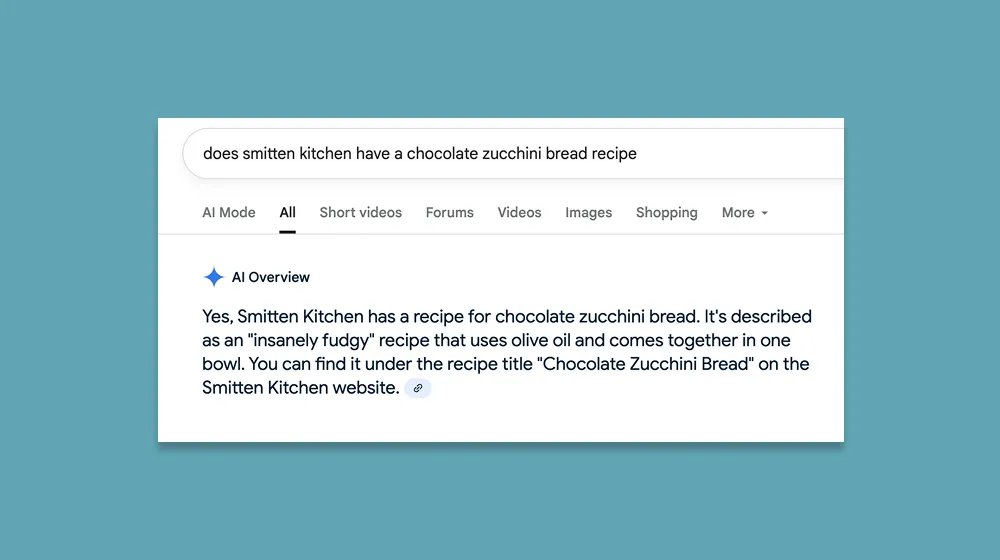
Like library patrons insisting that a hallucinated book is being hidden from view, undiscerning readers see the AI Overview and give it the weight it appears to demand, top of the page where the snippets used to sit1.
It must feel like manifest destiny to create something because it’s the thing that people expected you to create. Pushing your creativity onto rails, a track laid down by faceless language machinery.
You can’t copyright recipes, a fact that both enables and enforces an industry where creators are required to add their own accompanying perspective. The underlying instructions lend themselves to infinite remixing to match resources (do I have enough sugar), requirements (I’m allergic to coconut) and preference (I reckon this would be good with chocolate chips). LLMs have turned up the tempo on a flourishing ecosystem of chopped and screwed recipes.
The obvious problem here is that without a human preparing, cooking and tasting the resulting recipes, there’s a reduced likelihood that they’re any good. In fact, there’s no guarantee that they will respect the laws of physics, never mind gastronomy.
It’s yet another example where AI is building a world that fails novices. Newcomers to cooking are at a disadvantage. Without the intuition honed from the experience of cooking real dishes for real eaters, you might miss that, say, cooking a 6-inch cake for 3 to 4 hours will for certain leave you with an overcooked hunk of “charcoal.”
Computer Scientist Andrej Karpathy likens AI forms to “summoning ghosts”.
They are these imperfect replicas, a kind of statistical distillation of humanity’s documents with some sprinkle on top.
It turns out AI is reminding many of ghosts2. I imagine a phantom Deb and a spectral Adrian writing recipes and developing software, reading the lines fed to them by the collapse of culture into vector embeddings.
I’ve been using Smitten Kitchen recipes for over a decade. After making her banana bread, pasta and chicken hundreds of times, I trust that Perelman has put the work in to share the best possible version of each recipe. This trust network is being eroded in the face of AI-generated recipes and photos of food.
By choosing to ship the feature and write the recipe these individuals are doing the inevitable to minimise confusion and appeal to their existing audience. They are faced with an onslaught of hallucinated support requests and the risk of negative feedback for something outside their control.
I can’t find examples of folks describing how they resisted the call to merge with their phantom selves3. Maybe I haven’t looked hard enough but I suspect this is because they are buried under the growing mounds of slop that are squeezing them out.
The truth takes 45 minutes, the lies are ready in 5.
Perelman and others are creators in an uncertain time and it’s rare to find discussions of the economic reality for anyone hoping to do the same. The auto-generation of simulacra of recipes costs the sloppers next to nothing, but costs the actual bakers and the displaced creators everything.
Footnotes
-
I note that the snippets did, eventually, get better. This must be inevitable for AI Overviews but it’s alarming that they’re causing so much damage in the meantime. ↩
-
In addition to the propensity for models to produce rhetoric with countless overt references to ghosts, as noted by Sam Biddle in the New York Times Magazine. ‘When I asked it to write a science-fiction story, it featured a data-thief protagonist called, inevitably, Kael, who “wasn’t just good—he was a phantom,” alongside a love interest called Echo and a rogue A.I. called the Ghost Code.’ ↩
-
Against my best instincts I’ll occasionally tell Claude that I’m “heading to bed for the night so we’ll pick this up in the morning.” It’s intended as a checkpoint in our work but perhaps an acknowledgement that I’m already partially merged. ↩